Showing posts with label Transgender. Show all posts

17 January 2023

Looking on the bright side vs. misrepresenting evidence: WPATH review of outcomes of medicalized minors

The health care systems of the U.K., Finland, and Sweden have each conducted systematic, comprehensive reviews of the safety and effectiveness of puberty-blockers and cross-sex hormones on adolescents with gender dysphoria.  Such reviews are the standard procedure when developing health care policy.  All three reviews concluded that there is little evidence of benefit off-setting the known and unknowns risks of medicalized transition of minors.

In updating its Standards of Care (version 8), WPATH published its own review of effectiveness (Baker et al., 2021).  Unlike Europe, however, that review did not include safety in the scope of the review and came to this very positive (if qualified) conclusion about effectiveness:

If one wanted simply to advocate for medicalized transition, one would just quote the highlighted portion of the abstract and call it a day.  A good researcher, however, would continue to the actual data tables to search for the source of the contradiction.

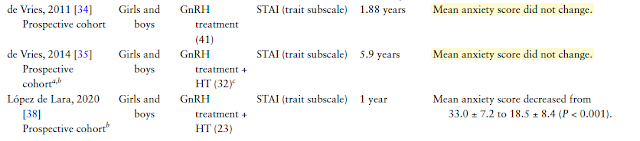
That source wasn't hard to find.  The article showed the outcomes across three tables, one each for transition results on quality of life (QOL), on depression, and on anxiety:


Table 2. 

Effects of Gender-Affirming Hormone Therapy on Quality of Life Among Transgender People


Table 3. 

Effects of Gender-Affirming Hormone Therapy on Depression Among Transgender People


Table 4. 

Effects of Gender-Affirming Hormone Therapy on Anxiety Among Transgender People


In short, the research included eight analyses of effectiveness on children: four showing improvement, and four showing failure to improve.  Yet, instead of describing these results as "mixed" or "inconsistent," the abstract reads "Hormone therapy was associated with increased QOL, decreased depression, and decreased anxiety."

To the authors' credit, the article did include another important result, one which I have yet to hear applied in discussions of the issue: "It was impossible to draw conclusions about the effects of hormone therapy on death by suicide" (Baker et al., 2021, p. 12).


References

Achille, C., Taggart, T., Eaton, N. R., Osipoff, J., Tafuri, K., Lane, A., & Wilson, T. A. (2020). Longitudinal impact of gender-affirming endocrine intervention on the mental health and well-being of transgender youths: Preliminary results. International Journal of Pediatric Endocrinology, 8.

Baker, K. E., Wilson, L. M., Sharma, R., Dukhanin, V., McArthur, K., & Robinson, K. A. (2021). Hormone therapy, mental health, and quality of life among transgender people.  Journal of the Endocrine Society, 5. https://doi.org/10.1210/jendso/bvab011  

de Vries, A. L. C., Steensma, T. D., Doreleijers, T. A. H., & Cohen-Kettenis, P. T. (2011). Puberty suppression in adolescents with gender identity disorder: A prospective follow-up study. Journal of Sexual Medicine, 8, 2276–2283.

de Vries, A. L., McGuire, J. K., Steensma, T. D., Wagenaar, E. C., Doreleijers, T. A., & Cohen-Kettenis, P. T. (2014). Young adult psychological outcome after puberty suppression and gender reassignment. Pediatrics, 134, 696-704.

López de Lara, D., Pérez Rodríguez, O., Cuellar Flores, I., Pedreira Masa, J. L., Campos-Muñoz, L., Cuesta Hernández, M., & Ramos Amador, J. T. (2020). Psychosocial assessment in transgender adolescents. Anales de Pediatría, 93, 41–48.

WPATH (2022). Standards of Care, version 8. https://www.wpath.org/soc8


10 October 2022

What I would have told Jon Stewart

 Jon Stewart recently interviewed Leslie Rutledge, the Attorney General of Arkansas, regarding medicalized treatments of children with gender dysphoria.  Unfortunately, they both were missing information that, if brought out, would have led to a very different conversation.  (For the record: I am not taking any position on any public policy, in Arkansas or elsewhere, and am instead providing the missing information to help any policy be based on the best evidence available.) 

Stewart repeatedly referred to clinical guidelines of four American associations as research-based and peer-reviewed.  That claim is incorrect.  Of these groups, only two have actually released clinical guidelines (the American Academy of Pediatrics and the Endocrine Society, see below).  The other two (the American Medical Association and American Psychiatric Association) have released various statements on the topic, but not guidelines or standards, and none of any of these groups undertook peer review with any of these documents.

When asked, Rutledge was unable to name which medical bodies reviewed the existing research and found it wanting.  Those bodies are: the National Health Service of the U.K. and the National Board of Health and Welfare of Sweden.  Both governments engaged in systematic and comprehensive reviews of all the research available and concluded that the evidence does not support medicalized treatment for minors with gender dysphoria.  That is, Stewart asked the wrong questions: Rather than asking why someone would depart from the American associations, he should have been asking why the American associations are out of step with the international health care systems conducting the systematic reviews that the American associations are not.

Stewart repeatedly named the Endocrine Society and the American Academy of Pediatrics (AAP) as if doing so were sufficient evidence of a scientific base; however, neither the Endocrine Society nor the AAP guidelines provide any such thing. The Endocrine Society assessed the science and clinical recommendations with these ratings:

[S]trong recommendations use the phrase “we recommend” and the number 1, and weak recommendations use the phrase “we suggest” and the number 2.

Cross-filled circles indicate the quality of the evidence, such that ⨁◯◯◯ denotes very low-quality evidence; ⨁⨁◯◯, low quality; ⨁⨁⨁◯, moderate quality; and ⨁⨁⨁⨁, high quality.

The Endocrine Society guideline for adolescents is:


In every category, without exception, the research quality was rated low or very low (⨁⨁◯◯ or ⨁◯◯◯).

As noted, the AAP’s guidelines did not undergo any peer review either; however, my own published fact-check of AAP’s claims did undergo peer review and showed, point-by-point, not only that the AAP’s claims were unsupported by the sources they cited, but also that those sources showed the very opposite of what AAP said they contained.  The AAP has never responded.

When asked to compare paediatric cancer to gender dysphoria: With cancer, we have objective evidence of a physical disease, as demonstrated by objective and highly accurate diagnostic procedures.  The risk:benefit ratio is quite different from gender dysphoria, which consists of only subjective evidence, running opposite to all physical indicators of health, all in the absence of any diagnostic test or demonstration of accuracy of anyone's clinical judgments.  In cancer, one removes objectively diseased tissue.  In trans, one removes objectively healthy tissue.

The Attorney General claimed that 98% of children later cease to feel transgender.  Stewart called that number made up, but never provided the correct number.  The correct number is actually a range: There have been 11 studies following up prepubescent children, and across the large, prospective studies, 61–88% of the children ceased to feel gender dysphoric by puberty.  (I’ve listed the 11 studies and their results here.)

The final major point they discussed regarded death by suicide as a consequence of failing to permit children to transition.  The evidence does not align well with the idea that refusing or delaying transition leads to suicide.  The evidence aligns very well, however, with the hypothesis that adolescents with Borderline Personality Disorder (or other issues) are mistaking their experience to indicate gender dysphoria when they are actually experiencing something else.  Although the American Psychiatric Association has not produced treatment guidelines, they have produced a diagnostic manual, including these two symptoms of Borderline Personality Disorder (BPD):

  • Identity disturbance: markedly and persistently unstable self-image or sense of self
  • Recurrent suicidal behaviour, gestures, or threats, or self-mutilating behavior

That is, unstable identity issues are being mistaken for gender identity issues, and the suicidality of BPD is being mistaken for suicidality from transphobia.  Like adolescent-onset gender dysphoria (the type most commonly approaching clinics today), BPD begins to manifest in adolescence, is three times more common in biological females than males, and occurs in 2–3% of the population, rather than 1-in-5,000 people.  By mistaking cases of BPD as cases of gender dysphoria, we fail to direct these youth to the types of therapy they actually need.  (The state of the art therapy for BPD is called “Dialectical Behavior Therapy.”)

Finally, I was surprised to hear Stewart treat the word “experimental” with a symmetric burden of proof: In medical ethics, “do” and “do nothing” are not interchangeable.  Primum non nocere.


09 August 2021

CAAPS, ROGD, and the science neglected

A statement was just released by the Coalition for the Advancement & Application of Psychological Science (CAAPS), calling for the elimination of the use of Rapid-Onset Gender Dysphoria (ROGD), “given the lack of rigorous empirical support for its existence.”  CAAPS is an umbrella organization of other psychology associations with the expressed purpose of promoting evidence-based practice, and their full ROGD statement is available here.

Despite the mission of the organization, CAAPS’ statement not only failed to arrive at the scientifically correct answer, but also it failed even to ask the correct scientific question.  The question has never been (and isn’t supposed to be) whether ROGD exists: The question is whether the recent and explosive increase in trans referrals being reported across the world (e.g., de Graaf et al., 2018; Frisén et al., 2017; Kaltialo-Heino et al., 2020; Wood et al., 2013) represents one of the previously well-characterized profiles of trans people (so we would know what to do) or something new (wherein we can’t).

The available evidence suggests it is something new: These people are quite dissimilar from previous groups on multiple objective variables, including age of onset, sex ratio, and comorbid mental health issues (Aitken et al., 2015; Ashley, 2019; Becker et al., 2014; Kaltiala-Heino et al., 2015; Littman, 2018; Wood et al., 2013).  That is, we cannot merely assume that the outcomes research from the already known trans profiles applies to this one.  Despite some initial indication of improvement on some variables after transition for adolescents (de Vries et al., 2011), such benefits have largely failed to replicate, despite multiple attempts, instead emerging as a general lack of improvement relative to controls (e.g., Achille et al., 2020; Carmichael et al., 2021; Costa et al., 2015; Kuper et al., 2020; van der Miesen et al., 2020).  The researchers repeatedly concluded that “[M]ost predictors did not reach statistical significance” (Achille et al., 2020, p. 3, italics added) and “The present study can, therefore, not provide evidence about the direct benefits of puberty suppression overtime and long-term mental health outcomes” (van der Miesen et al., 2020, p. 703, italics added).  Indeed, even de Vries’ original report of improvement was only mixed—although improved on some variables, the sample worsened on others, including on body satisfaction.  Notably, another claim of improvement (Bränström & Pachankis, 2019) was withdrawn after its statistical errors were identified and its data re-analyzed (Kalin, 2020).  One of the authors of that now retracted finding (Pachankis) is one of the two people whom CAAPS’ offers as media spokespersons for GLBTQ+ issues (full list here).

Scientifically, it doesn’t actually matter if ROGD exists as CAAPS considers: What matters is whether and what kinds of transition benefit the people fitting this profile, which we cannot know.  To declare that ROGD doesn’t exist without pointing this out, however, is to recommend treating ROGD as if it were ‘regular’ gender dysphoria by default, despite that we already know the people fitting the ROGD profile significantly differ from the samples represented in the gender dysphoria outcomes research.  One cannot conduct the ethical task of a risk:benefit ratio while lacking knowledge of the latter.

It is quite plausible that ROGD doesn’t exist as a gender dysphoria.  “ROGD” is only a shorthand description of the most salient feature by which people with this profile differ from the known profiles (they lack a childhood history of gender dysphoria; Littman, 2018).  I suspect very many such cases will turn out to be better helped if treated as manifestations of other, already known phenomena, such as Borderline Personality Disorder (which includes identity disturbance and unstable self-image) or an autism spectrum disorder.  Such was largely the case with ‘Recovered Memory Syndrome’: In an era when cases of child sexual abuse were finally receiving overdue attention, other people with unhealthy needs for attention began claiming the same, and credulous clinicians failed to challenge clients, instead becoming enablers of the unhealthy bids for attention.

Lacking from CAAPS’ statement was any indication of what might falsify their belief:  On how many (more) objective—i.e., non-self-report—variables do differences have to be demonstrated before we can treat ROGD as a different phenomenon from previous groups of trans people?  How many (more) failures to replicate evidence of benefit to transitioning for this new profile would merit a slow-down to transition-on-demand for the people showing it?

None of this should be taken at all to be denying/dismissing people’s reports of dysphoria or distress.  Rather, I point out (by way of analogy) that clinicians need to do different things to help people with major depression vs. bipolar depression vs. postnatal depression, despite that they can feel similar and would be described similarly.  Although we do not yet have enough evidence to tell us exactly what ROGD is, we do have sufficient evidence to know what it is not.  Treating this demonstrably new presentation the same as the known ones is to declare, ‘They all look alike to me.’

Updated 16-Aug-2021

References

Achille, C., Taggart, T., Eaton, N. R., Osipoff, J., Tafuri, K., Lane, A., & Wilson, T. A. (2020).  Longitudinal impact of gender-affirming endocrine intervention on the mental health and well-being of transgender youths: Preliminary results. International Journal of Pediatric Endocrinology. doi: 10.1186/s13633-020-00078-2 

Aitken, M., Steensma, T. D., Blanchard, R., VanderLaan, D. P., Wood, H., Fuentes, A. … Zucker, K. J. (2015).  Evidence for an altered sex ratio in clinic-referred adolescents with gender dysphoria. Journal of Sexual Medicine, 12, 756–763.

Ashley, F. (2019). Shifts in assigned sex ratios at gender identity clinics likely reflect changes in referral patterns [Letter to the Editor]. Journal of Sexual Medicine, 16, 948–949.

Becker, I., Gjergji-Lama, V., Romer G., & Möller, B. (2014).  Characteristics of children and adolescents with gender dysphoria referred to the Hamburg Gender Identity Clinic [German].  Prax Kinderpsychol Kinderpsychiatr, 63, 486–509.

Bränström, R., & Pachankis, J. E. (2019). Reduction in mental health treatment utilization among transgender individuals after gender-affirming surgeries: A total population study. American Journal of Psychiatry, 177, 727–734.

Carmichael, P., Butler, G., Masic, U., Cole, T. J., De Stavola, B. L., Davidson, S., Skageberg, E. M., Khadr, S., & Viner, R. M. (2021). Short-term outcomes of pubertal suppression in a selected cohort of 12 to 15 year old young people with persistent gender dysphoria in the UK. PLosONE, 16(2): e0243894.

Costa, R., Dunsford, M., Skagerberg, E., Holt V., Carmichael, P., & Colizzi, M. (2015). Psychological support, puberty suppression, and psychosocial functioning in adolescents with gender dysphoria. Journal of Sexual Medicine, 12, 2206–2214.

de Graaf, N. M., Giovanardi, G., Zitz, C., & Carmichael, P. (2018). Sex ratio in children and adolescent referred to the Gender Identity Development Services in the UK (2009–2016) [Letter to the Editor]. Archives of Sexual Behavior, 47, 1301–1304. 

de Vries, A. L. C., Steensma, T. D., Doreleijers, T. A. H., & Cohen-Kettenis, P. T. (2011). Puberty suppression in adolescents with gender identity disorder: A prospective follow-up study. Journal of Sexual Medicine, 8, 2276–2283.

Frisén, L., Söder, O., & Rydelius, P. A. (2017). [Dramatic increase of gender dysphoria in youth]. Lakartidningen.  Retrieved from http://lakartidningen.se/Klinik-och-vetenskap/Klinisk-oversikt/2017/02/Kraftig-okning-av-konsdysfori-bland-barn-och-unga/.

Kalin, N. H. (2020). Reassessing mental health treatment utilization reduction in transgender individuals after gender-affirming surgeries: A comment by the Editor on the process. American Journal of Psychiatry, 177, 765.

Kaltiala-Heino, R., Sumia, M., Työläjärvi, M., & Lindberg, N. (2015). Two years of gender identity service for minors: Overrepresentation of natal girls with severe problems in adolescent development. Child and Adolescent Psychiatry and Mental Health, 9, 9.

Kaltialo-Heino, R., Carmichael, P., de Graaf, N., Rischel, K., Frisén, L., Suomalainen, L., & Wahre, A. (2020). Time trends in referrals to child and adolescent gender identity services: A study in four Nordic countries and the UK. Nordic Journal of Psychiatry, 74, 40–44. 

Kuper, L. E., Stewart, S., Preston, S., Lau, M., & Lopez, X. (2020). Body dissatisfaction and mental health outcomes of youth on gender- affirming hormone therapy. Pediatrics, 145, e20193006.

Littman, L. (2018). Parent reports of adolescents and young adults perceived to show signs of a raid onset of gender dysphoria. PLoS ONE, 13(8), e0202330.

van der Miesen, A. I. R., Steensma, T. D., de Vries, A. L. C., Bos, H., & Popma, A. (2020). Psychological functioning in transgender adolescence before and after gender-affirmative care compared with cisgender general population peers. Journal of Adolescent Health, 66, 699–704.

Wood, H., Sasaki, S., Bradley, S. J., Singh, D., Fantus, S., Owen-Anderson, A., … Zucker, K. J. (2013). Patterns of referral to a gender identity service for children and adolescent (1976–2011): Age, sex ratio, and sexual orientation [Letter to the Editor]. Journal of Sex and Marital Therapy, 39, 1–6.

13 October 2020

Bill C-6

On October 1st, the Canadian government proposed legislation banning conversion therapy on anyone under 18, using this definition of conversion therapy (C-6 proposal):

320.‍101In sections 320.‍102 to 320.‍106, conversion therapy means a practice, treatment or service designed to change a person’s sexual orientation to heterosexual or gender identity to cisgender, or to repress or reduce non-heterosexual attraction or sexual behaviour. For greater certainty, this definition does not include a practice, treatment or service that relates
(a)to a person’s gender transition; or 
(b)to a person’s exploration of their identity or to its development.​

Unfortunately, that definition repeats a common error: It treats sexual orientation and gender identity as the same.  As pointed out previously however, there is no such thing as conversion therapy for gender identity: The existing evidence pertains to sexual orientation and only to sexual orientation.  [For a review, see Cantor (2019) or Cantor (2018).]

Although the proposal includes language apparently aimed at protecting legitimate therapy from the ban, the language is ambiguous (at best), so provides only ambiguous protection.  Especially in the current environment, we have every reason to expect extremists to declare that anything and everything other than immediate affirmation counts as conversion therapy.  Because there do not exist any manuals or research on conversion therapy for gender identity (again, there actually is no such thing), I do not know how a person, court, or policy-maker might decide what might be in or out.  Everyone has, so far, merely adopted something from sexual orientation conversion therapy attempts and imagined a gender identity equivalent.  One would reasonably predict a chill effect across licensed mental health providers making the service essentially unavailable.

I do not understand the language of part (a).  A practice that “relates to a person’s gender transition” would seem to cover every aspect of the entire issue, including efforts to avoid a gender transition.  Similarly incomprehensible to me is part (b), which together with the intro says, “conversion therapy means a practice…designed to change gender identity to cisgender [but] does not include a practice...that relates...to its development”.  It is not possible for something to relate to development and not relate to change.  Moreover, because the (purported) point of conversion therapy is to develop a new orientation/identity, this language would appear to excuse all of what it is attempting to ban.  I can imagine only that there must be legal/political meanings I am not appreciating, as this appears to me to be self-contradictory word salad.


Next, to refer to anything as an “exploration” is to assume there exists something solid and unchanging that we need only to observe.  Although the evidence indicates that sexual orientation fits that description, there is no evidence that gender identity does.  


Ultimately, the text does not resolve the basic situation: A child attends a clinic and does not know what their identity is.  “Exploration” can meaningfully include doing one’s best to feel comfortable with the original gender before approving medical or other dramatic interventions.  The efforts to become comfortable in the original gender would be indistinguishable from (or misrepresentable as) conversion therapy wherein cisgender is the goal rather than being the step that happens to have the least associated risk and therefore gets tried first.

08 July 2020

When is a "TERF" not a TERF?

In the responses to JK Rowling’s challenge to the more extremist (and vocal) factions of transgender activists, there has been much more name-calling than reasoning.  The most common such epithet has been to call her (or anyone else) a TERF, a “trans-exclusionary radical feminist.” 

Having been deeply involved in the science and clinical care of trans people for more than two decades, I have watched this particular term evolve and lose whatever meaning it originally had.  It used to refer to the most extreme of the other side:  There do indeed exist genuinely transphobic people who will refuse to recognize anyone’s transition under any circumstances and are accurately called TERF’s.  Now just a social media meme however, the term is bandied so broadly that it no longer carries any meaning at all.

I must first challenge the ironically binary premise that “exclusion” is all or none.  It’s only in the current climate of extremism that no moderate views get discussed.  Here is a range of some areas in which sex/gender require protection:

• Employment
• Housing
• Public accommodation…
• Locker rooms/showers, with nudity (sauna, hottub…)
• Locker rooms/washrooms, sex segregated
• Competitive sports teams, where physical size is an advantage

It would be perfectly accurate to call someone “trans exclusionary” for rejecting transpeople from all of these.  But that’s not meaningfully the same as (for example) a cis-woman who supports all civil rights, but feels uncomfortable naked in a locker room with a person whose every external feature is male (i.e., their female features are all internal).  I’m not saying I *agree* with this hypothetical cis-woman—I am pointing out the error of painting this entire range of opinions with a single dichotomous brush and dismissing them all as if they were all the most extreme imaginable.

Also on a spectrum is the point during transition at which one can/may/should be deemed which sex:

• Upon declaration
• Upon psych/medical exam/approval
• Upon declaration *despite* psych/medical exam results
• Upon part-time social living
• Upon full-time social living
• Upon hormone treatment
• Upon genital surgery
• Never

It’s easy to recognize “never” as genuinely transphobic/exclusionary.  But it is not meaningful to use the same term for everyone who breaks from the opposite extreme, based only on a recent (sometimes even curiously convenient) self-declaration.

Relatedly, there also exists debate over the age at which a youth should be permitted to begin to transition, socially and/or medically:

• Prepuberty (upon request/demand from child)
• Age 12 (mid-puberty, breaking point in outcomes research)
• Age 16 (usual age of consent for sex)
• Age 18 (legal age of adulthood)
• Age 25 (final brain maturation)
• Never

I support age 12, not for any ideological reason, but because that is what the (current) evidence supports:  The majority of prepubescent kids cease to feel trans during puberty, but the majority of kids who continue to feel trans after puberty rarely cease.  To someone who supports “upon demand,” however, everyone everywhere else on the spectrum is the same as the farthest opposite extreme.  It is not meaningful to claim that wait-until-12 is the same as never.

To repeat, I am not actually taking sides on any of these issues (except to indicate what is vs. not consistent with the science).  Rather, I am pointing out that “TERF” does not meaningfully convey anyone’s ideas about anything.  It is being used only as an epithet, to discredit rather than inform, holding even the slightest symbolic evidence of the smallest departure from one extreme as proof of membership of the other extreme....It is being used as an excuse not to engage with what the person is *actually* saying.

22 September 2019

It may sound PC, but van Anders et al. is a Trojan horse of language politics.

An essay about how to talk about trans issues at professional conferences has just been circulated by a group of five academics: Sari van Anders, M. Paz Galupo, Jay Irwin, Markie L. C. Twist, and Chelsea J. Reynolds.  (The essay is downloadable at Talking about Transgender Experiences, Identities, and Existences at Conferences.) In it, the authors "wanted to provide some guidelines for discussing studies with trans and transgender people, experiences, existences, backgrounds, and identities, and related aspects of gender diversity, at conferences for those individuals unaware or ignorant of current best practices or approaches".

Although I am strong advocate of consistency in language, just so we can all be sure when we are talking about the same/different things, I am frankly uncomfortable when someone—anyone—tells me what I may and may not say.  This document adds to the long and growing history of activists silencing scientists on this and other controversial issues.  Although I share 95% agreement with the document authors on many of these issues, I find it helpful to apply this bias-detector to myself: What if the same/equivalent thing came from a couple of people who I generally disagree with?  For example (I’m a devout atheist), what if a group of radically religious people posted how I, a scientist, may refer to god (or God) and whatever beliefs in my work and presentations?  


In that context, the power dynamics are more apparent, but the principle is the same.  We either apply it equally to people we agree or disagree with, or we are merely hypocrites doing unto others exactly the crimes that have been done unto us.


The language around trans issues is more than highly politicized.  This is true not only for the language recommendations in the document, but also in their absence.  For example, despite that every follow-up study of gender dysphoric kids showed that they will develop into cis-gendered gays/lesbians, the word “desistance” does not so much as appear in the document, even once.  The entire concept is disappeared.  


The document’s authors do not include clinicians:  The fields of expertise of the document’s authors are: neuroendocrinology, sociology, human development, communications, and experimental psychology.  None of them—not one—has borne the diagnostic/clinical responsibility of clients transitioning or de-transitioning or undergoing the process to decide.  Their experiences are their personal experiences (to the extent that some are openly trans): perfectly valid, but no more so than other peoples’, including the people they left out.  For example, the authors of the document include no desisters…again consistent with the complete disappearing of desistance in the document, despite that all the evidence indicates that the majority of children desist.


The message in leaving out desistance in conference language recommendations is, of course, that we may not talk about desistance at all.


Although the authors’ experiences are perfectly valid, this was not merely the sharing of language suggestions.  This was a declaration that “Because my path was the right path for me, my path is the right path for everyone” or “I didn’t desist, so there’s no such thing as desistance” or “The door to diverse experiences must be opened up enough for me, but no further.”  


We must not do unto others as was done unto us.

17 October 2018

American Academy of Pediatrics policy and trans- kids:
Fact-checking


The American Academy of Pediatrics (AAP) recently published a policy statement entitled, Ensuring comprehensive care and support for transgender and gender-diverse children and adolescents (Rafferty, 2018).  It was quite a remarkable document: Although almost all clinics and professional associations in the world use what’s called the watchful waiting approach to helping GD children, the AAP statement rejected that consensus, endorsing only gender affirmation.  With AAP taking such a dramatic departure from other professional associations, I was immediately curious about what evidence led them to that conclusion.  (Extraordinary claims require extraordinary evidence, and all that.)  As I read the works on which they based their policy however, I was pretty surprised…rather alarmed, actually:  These documents simply did not say what AAP claimed they did.  In fact, the references that AAP cited as the basis of their policy instead outright contradicted that policy, repeatedly endorsing watchful waiting. 

The AAP statement was also remarkable in what it left out—namely, the outcomes research on GD children.  There have been eleven follow-up studies of GD children, of which AAP cited one [Wallien & Cohen-Kettenis (2008)], doing so without actually mentioning the outcome data it contained.  The literature on outcomes was neither reviewed, summarized, nor subjected to meta-analysis to be considered in the aggregate—It was merely disappeared.  (I have presented the complete list of the outcome studies on this blog before; they appear again at the bottom of this page together with their results, for reference.)  As they make clear, every follow-up study of GD children, without exception, found the same thing: By puberty, the majority of GD children ceased to want to transition.  AAP is, of course, free to establish whatever policy it likes on whatever basis it likes.  But any assertion that their policy is based on evidence is demonstrably false, as detailed below. 

AAP divided clinical approaches into three types—conversion therapy, watchful waiting, and gender affirmation.  It rejected the first two and endorsed gender affirmation as the only acceptable alternative.  Most readers will likely be familiar already with attempts to use conversion therapy to change sexual orientation.  With regard to gender identity, AAP wrote:

“[C]onversion” or “reparative” treatment models are used to prevent children and adolescents from identifying as transgender or to dissuade them from exhibiting gender-diverse expressions….Reparative approaches have been proven to be not only unsuccessful38 but also deleterious and are considered outside the mainstream of traditional medical practice.29, 39–42

AAP’s citations are:
38.  Haldeman DC. The practice and ethics of sexual orientation conversion therapy. J Consult Clin Psychol. 1994;62(2):221–227
29.  Adelson SL; American Academy of Child and Adolescent Psychiatry (AACAP) Committee on Quality Issues (CQI). Practice parameter on gay, lesbian, or bisexual sexual orientation, gender nonconformity, and gender discordance in children and adolescents. J Am Acad Child Adolesc Psychiatry. 2012;51(9):957–974
39.  Byne W. Regulations restrict practice of conversion therapy. LGBT Health. 2016;3(2):97–99
40.  Cohen-Kettenis PT, Delemarrevan de Waal HA, Gooren LJ. The treatment of adolescent transsexuals: changing insights. J Sex Med. 2008;5(8):1892–1897
41.  Bryant K. Making gender identity disorder of childhood: historical lessons for contemporary debates. Sex Res Soc Policy. 2006;3(3):23–39
42.  World Professional Association for Transgender Health. WPATH De-Psychopathologisation Statement. Minneapolis, MN: World Professional Association for Transgender Health; 2010. Available at: https://www.wpath.org/policies. Accessed April 16, 2017

AAP's claims struck me as odd because there are no studies of conversion therapy for gender identity.  Studies of conversion therapy have been limited to sexual orientation—specifically, the sexual orientation of adults—not to gender identity, and not of children in any case.  The article AAP cited to support their claim (reference number 38) is indeed a classic and well-known review, but it is a review of sexual orientation research only.  Neither gender identity, nor even children, received even a single mention in it.  Indeed, the narrower scope of that article should be clear to anyone reading even just its title: “The practice and ethics of sexual orientation conversion therapy” (Haldeman, 1994, p. 221, italics added).

AAP continued, saying that conversion approaches for GD children have already been rejected by medical consensus, citing five sources.  This claim struck me just as odd, however—I recalled associations banning conversion therapy for sexual orientation, but not for gender identity, exactly because there is no evidence for generalizing from adult sexual orientation to childhood gender identity.  So, I started checking AAP’s citations for that, and these sources too pertained only to sexual orientation, not gender identity (specifics below).  What AAP’s sources did repeatedly emphasize was that:

(1)   Sexual orientation of adults is unaffected by conversion therapy and any other [known] intervention;
(2)   Gender dysphoria in childhood before puberty desists in the majority of cases, becoming (cis-gendered) homosexuality in adulthood, again regardless of any [known] intervention; and
(3)   Gender dysphoria in childhood persisting after puberty tends to persist entirely. 

That is, in the context of GD children, it simply makes no sense to refer to externally induced “conversion”: The majority of children “convert” to cisgender or “desist” from transgender regardless of any attempt to change them.  “Conversion” only makes sense with regard to adult sexual orientation because (unlike childhood gender identity), adult homosexuality never or nearly never spontaneously changes to heterosexuality.  Although gender identity and sexual orientation may often be analogous and discussed together with regard to social or political values and to civil rights, they are nonetheless distinct—with distinct origins, needs, and responses to medical and mental health care choices.  Although AAP emphasized to the reader that “gender identity is not synonymous with ‘sexual orientation’” (Rafferty, 2018, p. 3), they went ahead to treat them as such nonetheless.

To return to checking AAP’s fidelity to its sources: Reference 29 was a practice guideline from the Committee on Quality Issues of the American Academy of Child and Adolescent Psychiatry (AACAP).  Despite AAP applying this source to gender identity, AACAP was quite unambiguous regarding their intent to speak to sexual orientation and only to sexual orientation: “Principle 6. Clinicians should be aware that there is no evidence that sexual orientation can be altered through therapy, and that attempts to do so may be harmful.  There is no established evidence that change in a predominant, enduring homosexual pattern of development is possible.  Although sexual fantasies can, to some degree, be suppressed or repressed by those who are ashamed of or in conflict about them, sexual desire is not a choice.  However, behavior, social role, and—to a degree—identity and self-acceptance are. Although operant conditioning modifies sexual fetishes, it does not alter homosexuality.  Psychiatric efforts to alter sexual orientation through ‘reparative therapy’ in adults have found little or no change in sexual orientation, while causing significant risk of harm to self-esteem” (AACAP, 2012, p. 967, italics added). 

Whereas AAP cites AACAP to support gender affirmation as the only alternative for treating GD children, AACAP’s actual view was decidedly neutral, noting the lack of evidence: “Given the lack of empirical evidence from randomized, controlled trials of the efficacy of treatment aimed at eliminating gender discordance, the potential risks of treatment, and longitudinal evidence that gender discordance persists in only a small minority of untreated cases arising in childhood, further research is needed on predictors of persistence and desistence of childhood gender discordance as well as the long-term risks and benefits of intervention before any treatment to eliminate gender discordance can be endorsed” (AACAP, 2012, p. 969).  Moreover, whereas AAP rejected watchful waiting, what AACAP recommended was: “In general, it is desirable to help adolescents who may be experiencing gender distress and dysphoria to defer sex reassignment until adulthood” (AACAP, 2012, p. 969).  So, not only did AAP attribute to AACAP something AACAP never said, but also AAP withheld from readers AACAP’s actual view.

Next, in reference 39, Byne (2016) also addressed only sexual orientation, doing so very clearly: “Reparative therapy is a subset of conversion therapies based on the premise that same-sex attraction are reparations for childhood trauma. Thus, practitioners of reparative therapy believe that exploring, isolating, and repairing these childhood emotional wounds will often result in reducing same-sex attractions” (Byne, 2016, p. 97).  Byne does not say this of gender identity, as the AAP statement misrepresents.

In AAP reference 40, Cohen-Kettenis et al. (2008) did finally pertain to gender identity; however, this article never mentions conversion therapy. (!)  Rather, in this study, the authors presented that clinic’s lowering of their minimum age for cross-sex hormone treatment from age 18 to 16, which they did on the basis of a series of studies showing the high rates of success with this age group.  Although it did strike me as odd that AAP picked as support against conversion therapy an article that did not mention conversion therapy, I could imagine AAP cited the article as an example of what the “mainstream of traditional medical practice” consists of (the logic being that conversion therapy falls outside what an ‘ideal’ clinic like this one provides).  However, what this clinic provides is the very watchful waiting approach that AAP rejected.  The approach espoused by Cohen-Kettenis (and the other clinics mentioned in the source—Gent, Boston, Oslo, and now formerly, Toronto) is to make puberty-halting interventions available at age 12 because: “[P]ubertal suppression may give adolescents, together with the attending health professional, more time to explore their gender identity, without the distress of the developing secondary sex characteristics. The precision of the diagnosis may thus be improved” (Cohen-Kettenis et al., 2008, p. 1894).

Reference 41 presented a very interesting history spanning the 1960s–1990s about how feminine boys and tomboyish girls came to be recognized as mostly pre-homosexual, and how that status came to be entered into the DSM at the same time as homosexuality was being removed from the DSM.  Conversion therapy is never mentioned.  Indeed, to the extent that Bryant mentions treatment at all, it is to say that treatment is entirely irrelevant to his analysis: “An important omission from the DSM is a discussion of the kinds of treatment that GIDC children should receive. (This omission is a general orientation of the DSM and not unique to GIDC)” (Bryant, 2006, p. 35).  How this article supports AAP’s claim is a mystery.  Moreover, how AAP could cite a 2006 history discussing events of the 1990s and earlier to support a claim about the current consensus in this quickly evolving discussion remains all the more unfathomable.

Cited last in this section was a one-paragraph press release from the World Professional Association for Transgender Health.  Written during the early stages of the American Psychiatric Association’s (APA’s) update of the DSM, the statement asserted simply that “The WPATH Board of Directors strongly urges the de-psychopathologisation of gender variance worldwide.”  Very reasonable debate can (and should) be had regarding whether gender dysphoria should be removed from the DSM as homosexuality was, and WPATH was well within its purview to assert that it should.  Now that the DSM revision process is years completed however, history has seen that APA ultimately retained the diagnostic categories, rejecting WPATH’s urging.  This makes AAP’s logic entirely backwards: That WPATH’s request to depathologize gender dysphoria was rejected suggests that it is WPATH’s viewand therefore, AAP policywhich falls “outside the mainstream of traditional medical practice.” (!)

AAP based this entire line of reasoning on their belief that conversion therapy is being used “to prevent children and adolescents from identifying as transgender” (Rafferty, 2018, p. 4).  That claim is left without citation or support.  In contrast, what is said by AAP’s sources is “delaying affirmation should not be construed as conversion therapy or an attempt to change gender identity” in the first place (Byne, 2016, p. 2).  Nonetheless, AAP seems to be doing exactly that: Simply relabeling non-gender affirmation models as conversion clinics.

Although AAP (and anyone else) may reject (what they label to be) conversion therapy purely on the basis of political or personal values, there is no evidence to back the AAP’s stated claim about the existing science on gender identity at all, never mind gender identity of children.

AAP also rejected the watchful waiting approach, repeatedly calling it “outdated.”  The criticisms AAP provided, however, again defied the existing evidence, with even its own sources repeatedly calling that model the current standard.  According to AAP:

[G]ender affirmation is in contrast to the outdated approach in which a child’s gender-diverse assertions are held as “possibly true” until an arbitrary age (often after pubertal onset) when they can be considered valid, an approach that authors of the literature have termed “watchful waiting.” This outdated approach does not serve the child because critical support is withheld. Watchful waiting is based on binary notions of gender in which gender diversity and fluidity is pathologized; in watchful waiting, it is also assumed that notions of gender identity become fixed at a certain age. The approach is also influenced by a group of early studies with validity concerns, methodologic flaws, and limited follow-up on children who identified as TGD and, by adolescence, did not seek further treatment (“desisters”).45,47

The citations from AAP’s reference list are:
45.  Ehrensaft D, Giammattei SV, Storck K, Tishelman AC, Keo-Meier C. Prepubertal social gender transitions: what we know; what we can learn—a view from a gender affirmative lens. Int J Transgend. 2018;19(2):251–268
47.  Olson KR. Prepubescent transgender children: what we do and do not know. J Am Acad Child Adolesc Psychiatry. 2016;55(3):155–156.e3

I was surprised first by the AAP’s claim that pubertal onset was somehow “arbitrary.”  The literature, including AAP’s sources, repeatedly indicated the pivotal importance of puberty, noting that outcomes strongly diverge at puberty.  According to AAP reference 29, in “prepubertal boys with gender discordance—including many without any mental health treatment—the cross gender wishes usually fade over time and do not persist into adulthood, with only 2.2% to 11.9%  continuing to experience gender discordance” (Adelson & AACAP, 2012, p. 963, italics added), whereas “when gender variance with the desire to be the other sex is present in adolescence, this desire usually does persist through adulthood” (Adelson & AACAP, 2012, p. 964, italics added).  Similarly, according to AAP reference 40, “Symptoms of GID at prepubertal ages decrease or even disappear in a considerable percentage of children (estimates range from 80–95%).  Therefore, any intervention in childhood would seem premature and inappropriate. However, GID persisting into early puberty appears to be highly persistent” (Cohen-Kettenis et al., 2008, p. 1895, italics added).  That follow-up studies of prepubertal transition differ from postpubertal transition is the very meaning of non-arbitrary.  AAP gave readers exactly the reverse of what was contained in its own sources.  If AAP were correct in saying that puberty is an arbitrarily selected age, then AAP will be able to offer another point with as much empirical backing as puberty has.

Next, it was not clear on what basis AAP could say that watchful waiting withholds support—AAP cited no support for its claim.  The people in such programs often receive substantial support during this period.  Also unclear is on what basis AAP could already know exactly which treatments are “critical” and which are not—Answering that question is the very purpose of this entire endeavor.  Indeed, the logic of AAP’s claim appears entirely circular:  If one were pre-convinced that the gender affirmation is the only acceptable alternative, then watchful waiting withholds critical support only in the sense that it delays gender affirmation, the method one has already decided to be critical.

Although AAP’s next claim did not have a citation appearing at the end of its sentence, binary notions of gender was mentioned both in references 45 and 47.  Specifically, both pointed out that existing outcome studies have been about people transitioning from one sex to the other, rather than from one sex to an in-between status or a combination of masculine/feminine features.  Neither reference presented this as a reason to reject the results from the existing studies of complete transition however (which is how AAP cast it).  Although it is indeed true that the outcome data have been about complete transition, some future study showing that partial transition shows a different outcome would not invalidate what is known about complete transition.  Indeed, data showing that partial transition gives better outcomes than complete transition would, once again, support the watchful waiting approach which AAP rejected.

Next was a vague reference alleging concerns and criticisms about early studies.  Had AAP indicated what those alleged concerns and flaws were (or which studies they were), then it would be possible to evaluate or address them.  Nonetheless, the argument is a red herring: Because all of the later studies showed the same result as did the early studies, any such allegation is necessarily moot.

Reference 47 was a one-and-a-half page commentary which off-handedly mentions criticisms previously made of three of the eleven outcome studies of GD children, but does not provide any analysis or discussion (Olsen, 2016).  The only specific claim was that studies (whether early or late) had limited follow-up periods—the logic being that had outcome researchers lengthened the follow-up period, then people who seemed to have desisted might have returned to the clinic as cases of “persistence-after-interruption.”  Although one could debate the merits of that prediction, AAP (and Olson) instead simply withheld from the reader the result from testing that prediction directly:  Steensma and Cohen-Kettenis (2015) conducted another analysis of their cohort, by then ages 19–28 (mean age 25.9 years), and found that 3.3% (5 people of the sample of 150) later returned.  That is, the childhood sample showing 70.0% desistence instead showed 66.7% desistance in long-term follow-up.  It is up to the reader to decide whether that difference challenges the aforementioned conclusion that that majority of GD children cease to want to transition by puberty or represents a grasping at straws.

Reference
Steensma, T. D., & Cohen-Kettenis, P. T. (2015). More than two developmental pathways in children with gender dysphoria?  Journal of the American Academy of Child & Adolescent Psychiatry, 52, 147–148.

Reference 45 did not support the claim that watchful-waiting is “outdated.”  Indeed, that source said the very opposite, referring to watchful waiting as the current approach:  “Put another way, if clinicians are straying from SOC 7 guidelines for social transitions, not abiding by the watchful waiting model favored by the standards, we will have adolescents who have been consistently living in their affirmed gender since age 3, 4, or 5” (Ehrensaft et al., 2018, p. 255).  Moreover, Ehrensaft et al. said there are cases in which they too would still use watchful waiting: “When a child’s gender identity is unclear, the watchful waiting approach can give the child and their family time to develop a clearer understanding and is not necessarily in contrast to the needs of the child” (p. 259).  Ehrensaft et al. are indeed critical of the watchful waiting model (which they feel is applied too conservatively), but they do not come close to the position the AAP policy espouses.  Where Ehrensaft summarizes the potential benefits and potential risks both to transitioning and not transitioning, the AAP presents an ironically binary narrative.

In its policy statement, AAP told neither the truth nor the whole truth, committing sins both of commission and of omission, asserting claims easily falsified by anyone caring to do any fact-checking at all.  AAP claimed, “This policy statement is focused specifically on children and youth that identify as TGD rather than the larger LGBTQ population” (p. 1); however, much of that evidence was about sexual orientation, not gender identity.  AAP claimed, “Current available research and expert opinion from clinical and research leaders…will serve as the basis for recommendations” (p. 1-2); however, they provided recommendations entirely unsupported and even in direct opposition to that research and opinion.

AAP is advocating for something far in excess of mainstream practice and medical consensus.  In the presence of compelling evidence, that would be exactly called for.  The problems in Rafferty (2018), however, do not constitute merely a misquote, a misinterpretation of an ambiguous statement, or a missing reference or two.  Rather, AAP’s statement is a systematic exclusion and misrepresentation of entire literatures.  Not only did AAP fail to provide extraordinary evidence, it failed to provide the evidence at all.  Indeed, AAP’s recommendations are despite the existing evidence. 


------------------------------------------------------------------------------------------------------------------------


Outcome Studies of GD Children and Their Results

Count
 Group
Study
2/16
4/16
10/16
gay
trans-/crossdress
straight/uncertain
Lebovitz, P. S. (1972). Feminine behavior in boys: Aspects of its outcome. American Journal of Psychiatry, 128, 1283–1289.
2/16
2/16
12/16
trans-
uncertain
gay
Zuger, B. (1978). Effeminate behavior present in boys from childhood: Ten additional years of follow-up. Comprehensive Psychiatry, 19, 363–369.
0/5
5/5
trans-
gay
Money, J., & Russo, A. J. (1979). Homosexual outcome of discordant gender identity/role: Longitudinal follow-up. Journal of Pediatric Psychology, 4, 29–41.
2/45
10/45
33/45
trans-/crossdress
uncertain
gay
Zuger, B. (1984). Early effeminate behavior in boys: Outcome and significance for homosexuality. Journal of Nervous and Mental Disease, 172, 90–97.
1/10
2/10
3/10
4/10
trans-
gay
uncertain
straight
Davenport, C. W. (1986). A follow-up study of 10 feminine boys.  Archives of Sexual Behavior, 15, 511–517.
1/44
43/44
trans-
cis-
Green, R. (1987). The "sissy boy syndrome" and the development of homosexuality. New Haven, CT: Yale University Press.
0/8
8/8
trans-
cis-
Kosky, R. J. (1987). Gender-disordered children: Does inpatient treatment help? Medical Journal of Australia, 146, 565–569.
21/54
33/54

trans-
cis-

Wallien, M. S. C., & Cohen-Kettenis, P. T. (2008). Psychosexual outcome of gender-dysphoric children. Journal of the American Academy of Child and Adolescent Psychiatry, 47, 1413–1423.

3/25
6/25
16/25
trans-
lesbian/bi-
straight
Drummond, K. D., Bradley, S. J., Badali-Peterson, M., & Zucker, K. J. (2008). A follow-up study of girls with gender identity disorder. Developmental   Psychology, 44, 34–45.
17/139
122/139
trans-
cis-
Singh, D. (2012). A follow-up study of boys with gender identity disorder. Unpublished doctoral dissertation, University of Toronto.
47/127
80/127
trans-
cis-
Steensma, T. D., McGuire, J. K., Kreukels, B. P. C., Beekman, A. J., & Cohen-Kettenis, P. T. (2013). Factors associated with desistence and persistence of childhood gender dysphoria: A quantitative follow-up study. Journal of the American Academy of Child and Adolescent Psychiatry, 52, 582–590.

*For brevity, the list uses “gay” for “gay and cis-”, “straight” for “straight and cis-”, etc.